Specific Gravity Is Your Friend
How specific gravity can be used for mixing, testing, and reproducing glazes.

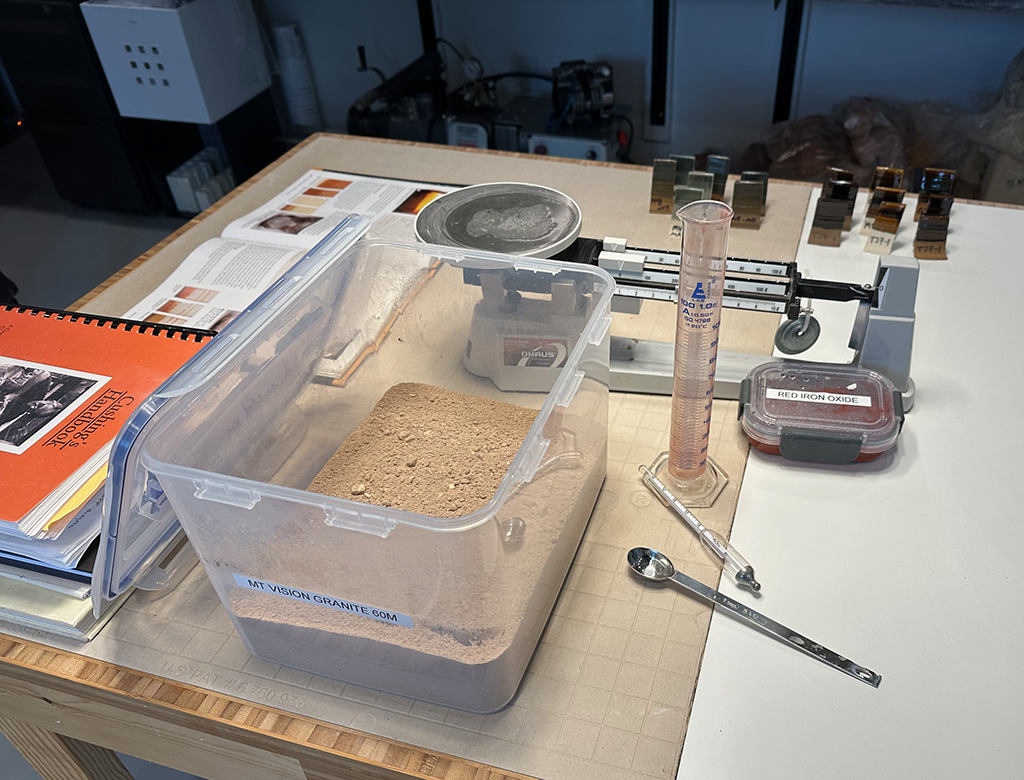
In ceramics, specific gravity is introduced when learning how to mix your own glazes, specific gravity being the ratio of the weight of a given volume of your mixed glaze compared to the same volume of water.
We learn why it is important to measure and record the specific gravity when one mixes a glaze, namely, to ensure it can be mixed again in the same way. In other words, while the dry ingredients define the recipe, knowledge of the water content is required for reproducibility.
In practice, then, we tune a glaze for application, adding or subtracting water, to find the specific gravity that works best and go on with life knowing we can achieve repeatable results if we keep that specific gravity constant.
Reproducibility is one reason why specific gravity is your friend, but there is another, that being the ability to measure a portion of a batch of mixed glaze and confidently know how much dry material it contains.
Why is this valuable? Formulating new glazes requires a lot of testing which in turn means making many small batches of a base glaze, say for line blends, etc. If you have many concurrent tests planned, this can lead to tedious and repetitive measuring of the same material, once for each test.
Wouldn't it be better to simply mix a big batch of base glaze, divide it up, and then conduct your line blends with confidence that the addition of new dry material will correspond accurately with the test you have planned?
Using specific gravity we can do this.
For example, let's say we have a 10 line blends in mind that all require we mix the same base glaze. If our base glaze has 3 ingredients we would need to make 30 scale measurements to create 10 samples of 200 grams each. Then we would have to add the same amount of water 10 times. We'd rather just mix 2000 grams of the base glaze, with 3 measurements, add water, and then divide this slurry into 10 cups and go from there.
To explain how we can do this, let's go back to the specific gravity relationship:
Specific Gravity, SG = (D + W) / W
where D is the weight of dry materials and W is the weight of water occupying the same volume. Rearranging we have
W = D / (SG - 1)
and substituting into S = D + W for W we have
Glaze Slurry, S = (D + W) = D * SG / ( SG - 1)
where S is the total slurry weight (dry + water).
This formula provides a way to divide a large batch of glaze into smaller batches where we will know with confidence the weight of the dry materials in the small batch and can proceed with our test.
For example, for the 10 line blend tests of 200 gm of dry material each, and knowing the big batch with 2000 grams of dry material has an SG of 1.5, we can use the equation above to calculate 600 grams of slurry are needed in each of the 10 cups (600 = 200 * 1.5 / (1.5 - 1)).
Or say we changed our minds and want a test sample of base glaze that corresponds to 150 gm of dry material and the SG of the large batch is 1.47. We would then pour out 150 * 1.47 / (1.47 - 1) = 469.15 grams of slurry for our test.
Theory vs Practice
The theory is great, but putting it into practice does require some process and patience since, following the 10 sample example, 10 cups of slurry now have to be poured and weighed.
We can obtain a starting point for how much to pour into each cup by rearranging the specific gravity relationship once again obtaining:
Volume ~= (D + W)target / SG = Starget / SG
which says the volume we want to pour is the weight of the target slurry Starget divided by its specific gravity. This works because the weight of water is more or less the same value as its volume at room temperature (1 milliliter of water ≈ 1 gram at room temperature; exactly 1 gram at 4°C).
With the example of SG = 1.5 and measuring 600 grams of slurry from our larger batch our target volume cup pour is 600 / 1.5 = 400 milliliters of slurry.
Note that the value of 400 milliliters is approximate given various inconsistencies that can exist in the slurry, therefore it's more accurate to continue to weigh, but at least this is a starting point and once a proper volume to weight measure is obtained empirically, pouring the rest of the samples becomes easier.
In addition to weighing, it is important to ensure that the large batch of glaze slurry is always well mixed, even while pouring. There is also inevitable material loss from sieving and spills, making it necessary to remeasure the specific gravity from time to time in case it drifts during the process.
The good news is that for testing, with a little bit of practice, this is a flexible and viable timesaving approach.
Brongniart’s Formula
Related to specific gravity one often encounters Brongniart’s formula in the ceramic literature. Brongniart was among the first to systematically apply specific gravity to ceramic materials in France in the early 19th century. His formula is another variation of the specific gravity formula presented above. Algebraically, the specific gravity relationship can be rewritten as:
D / S = (SG - 1) / SG
which gives the ratio of the weight of the dry material compared to the glaze slurry in terms of the specific gravity of the glaze slurry (and 1 - D/S gives the ratio of water weight to the slurry weight).
In other words, given SG, Brongniart's formula answers
"what fraction of this slurry is dry?"
while the problem described in this article answers the question
"how much slurry equals a chosen dry amount?".